
Start here
What exactly is Prentice Cooper?
Prentice Cooper State Forest sits in Marion County along the Tennessee River Gorge, roughly 10 miles west of Chattanooga. The state lists the forest at 26,945 acres. It was assembled from land purchased between 1938 and 1944 and officially proclaimed a state forest in 1945. [1]
This is an important distinction for a first visit: Prentice Cooper is not managed like a state park.Tennessee's state forests are working forests managed for timber, wildlife habitat, conservation, research, and recreation. Prentice Cooper also overlaps with a Wildlife Management Area, which is why hunting regulations and managed hunt closures matter even if you are only there to hike or drive forest roads. [1][3]
The recreation side is still huge. The state lists hiking, mountain biking, horseback riding, bird watching, rock climbing, camping, hunting, and OHV use on designated roads. There are about 35 miles of hiking trails, plus the southern end of the Cumberland Trail system. [1]
The easiest way to think about itIt is not an off-road park.It is a state forest with roads you are allowed to use.
For a first drive
You do not need a built Jeep just to explore Prentice Cooper.
One reason Prentice Cooper can be confusing online is that people talk about "off-roading" there like every road is a trail obstacle. That is not really how the forest is laid out.
The official road-use map separates roads into different categories. Some are marked as suitable for any vehicle. Others are described as rough, with high-clearance vehicles recommended. There are also narrow rough routes that are not suitable for vehicles over 50 inches, plus roads and trails that are foot traffic only. [2]
For a beginner, that is actually good news. You can have an enjoyable forest-road day without trying to turn the trip into a rock-crawling event. Start conservative, stay on the roads shown for your vehicle type, and turn around before a section gets beyond your comfort level.
Best place to learn the forest layout and get used to the gravel without making vehicle capability the entire trip.
Conditions can change with weather and traffic. This is where a stock 4x4 or similar vehicle starts making more sense.
Do not treat power lines, creeks, fields, hiking trails, or an old road trace as somewhere you are allowed to drive.
The Tennessee Division of Forestry is direct about the rules: motorized vehicles must stay on designated roads, the forest speed limit is 25 mph unless posted lower, and driving in woods, fields, creeks, utility rights of way, or around closure barricades is prohibited. [1][8]
Official Tennessee Division of ForestryOpen the Prentice Cooper Road Use MapFrom my own first trip
This is how I first took the Jeep into Prentice Cooper.
I had been to Prentice Cooper plenty of times before this trip, especially around the firing range, so the forest itself was not new to me. What was new was bringing our Hella Yella 2019 Jeep Wrangler Unlimited Sahara out there for its first real outing, just four days after we took delivery of it. It was also my kids' first time at Prentice Cooper.
The Jeep was basically stock, it was still our daily driver, we did not have another vehicle with us, and I did not have a proper trail map for exploring the road network that day. So we kept the Jeep side of the trip sensible. We stayed mostly on the main route, let the kids experience the forest for the first time, got some dirt under the tires, and resisted the urge to turn down every interesting side road just because the Jeep probably could.
The trip reinforced something I already liked about Prentice Cooper: you do not need a lift, giant tires, or a recovery story to make a good day out of the place. A mostly stock Wrangler, some restraint, and a relaxed family pace were enough to make it one of those days that immediately justified buying the Jeep.
The obvious first destination
Snoopers Rock is popular for a reason.
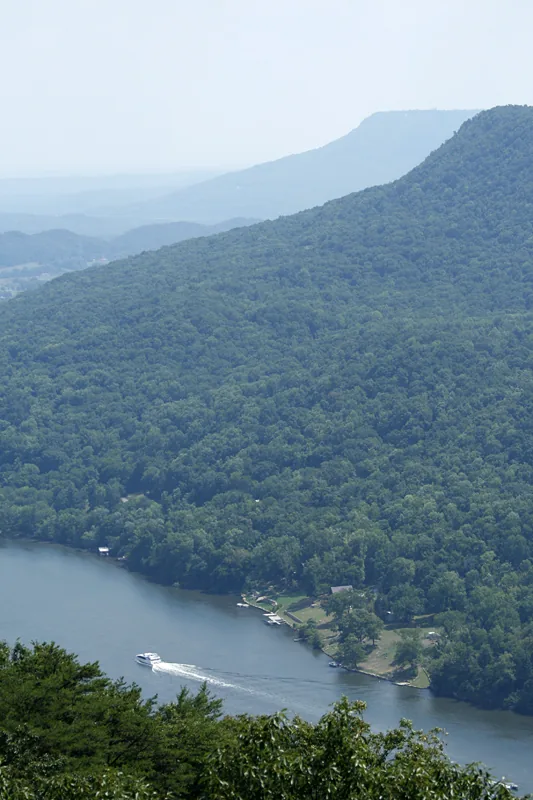
If you only know one place inside Prentice Cooper, it is probably Snoopers Rock. The overlook sits high above a bend in the Tennessee River Gorge and is one of the easiest ways to understand why this forest is worth exploring.
Snoopers Rock is connected to the Mullens Cove and Pot Point trail systems, but you do not have to hike either entire loop to see the overlook. Vehicle access normally gets you close enough for a short walk from the parking area. The Tennessee River Gorge Trust specifically notes that the overlook can be reached by foot, bike, or car. [7]
For a first trip, I would build the day around the drive through the forest and Snoopers Rock rather than trying to check off every road and trail on the map. Prentice Cooper is big enough that you can make yourself miserable trying to "finish" it in one visit.
If you want to hike
The famous loops are not beginner strolls.
Prentice Cooper has plenty of hiking, but some of the routes that show up most often in search results are full day hikes. Do not see the word "loop" and assume it means a quick walk.
The Cumberland Trail Conservancy describes a loop linking the main forest trailhead, Indian Rock House, Snoopers Rock, streams, overlooks, and campsites. It is a great sampler of the forest, but it is a real hike.[4][6]
Highlights include high overlooks of the Tennessee River Gorge and a natural bridge. The Conservancy lists about 400 feet of elevation change. [5]
Poplar Springs links the forest trail system toward Suck Creek Road, while the broader Tennessee River Gorge segment reaches toward Signal and Edwards Points.[6]
You can absolutely visit Prentice Cooper without committing to a ten-mile hike. Short out-and-back walks from road access points and overlooks make a lot more sense for a first scouting trip. Learn the roads and trailheads first. Come back for the bigger hike when that is the purpose of the day.
This part matters
Prentice Cooper can be closed even when the weather is perfect.
There are several different reasons access can change, and this is probably the single most important thing for a new visitor to know.
During scheduled managed big-game hunts, the area west of State Route 27, Suck Creek Road, is closed to visitors other than licensed hunters. Edwards Point on the east side remains open. [1][3]
The state closes Tower Drive past Pot Point Gate, side roads, and Haley Road from December 20 through March 15 to protect roads during wet freeze-thaw conditions. The state says Davis Pond campsite and Snoopers Rock remain accessible during that winter period. [1]
Several roads close after turkey season through July 14, including Persimmon Road and roads beyond Pot Point Gate, plus Inman Point, Long Point, and Elder Point roads.[1]
The published deer hunt schedule includes September 19 to 21, September 22 to 25, October 8 to 10, October 24 to 25, October 29 to 31, November 6 to 8, and November 28 through December 3. These dates affect public access west of Suck Creek Road. Always confirm the official schedule before leaving home. [1][3]
Staying overnight
Camping is primitive, not campground-resort camping.
The state forest page lists primitive camping at the Hunter Check Station and Davis Pond areas on a first-come, first-served basis. These sites do not have sanitation facilities. [1]
The WMA regulations also list Tennessee Wall Campground. Availability and access can change around managed hunts. Davis Pond has an additional rule that campers must arrive by sunset and remain in the campground until sunrise except for emergencies. [3]
That makes Prentice Cooper good for a simple forest camping trip, but it is not the place to arrive expecting hookups, showers, a camp store, or somebody at a desk waiting to check you in.
It is not just a Jeep place
Slow down enough to actually look around.
The forest's road network gets a lot of attention, but that is only one use of the property. TWRA specifically calls out woodland birding during spring and fall migration, with species such as Red-eyed Vireo, Ovenbird, Wood Thrush, and Scarlet Tanager common in summer. [3]
Prentice Cooper also contains scenic conservation zones and the 350-acre Hicks Gap Natural Area, which protects habitat for the federally endangered large-flowered skullcap.[1]
That is worth remembering when driving. The road is not the attraction by itself. It is just how you get through a very large piece of protected and actively managed forest.
A simple first visit
How I would approach day one
Look for hunt closures, weather closures, and seasonal road restrictions.
Cell service is not something I would build the entire day around.
It gives the trip a purpose without forcing you into a long hike or technical drive.
Use the first trip to learn the forest instead of chasing every line on somebody else's GPS track.
The WMA prohibits unauthorized presence between sunset and sunrise, with separate rules for authorized camping.[3]
A few things I would bring
You do not need an expedition loadout.
For a normal day trip I would want an offline copy of the road-use map, water, basic recovery gear if I am exploring the rougher roads, a tire inflator, a way to change a tire, and enough daylight that I am not trying to learn the forest in a hurry.
Hiking changes the list. Add proper footwear, more water, navigation, and enough time for the mileage you picked. Ten miles in Prentice Cooper is not the same thing as ten miles on a paved greenway.
I would also assume I may meet hikers, mountain bikers, hunters, horses, and other vehicles. The state specifically reminds drivers that these roads are shared and recommends stopping or shutting off an engine when necessary to avoid spooking horses. [1]
Quick answers
Prentice Cooper FAQ
Do I need four-wheel drive to visit Prentice Cooper?
No. The official state map includes roads listed as suitable for any vehicle as well as rougher roads where high clearance is recommended. Pick routes that match your vehicle and current conditions. [2]
Can I drive my Jeep anywhere I see an old road?
No. Motorized travel is restricted to designated roads. Roads not shown as open for motorized use, hiking trails, woods, fields, creeks, and utility rights of way are not legal shortcuts. [1][2]
Can I drive to Snoopers Rock?
Under normal open-road conditions, vehicle access gets you to the Snoopers Rock parking area with a short walk to the overlook. Seasonal or temporary road closures can change access, so check before the trip. [1][7]
Does the forest close during hunting season?
Not for every hunting day, but scheduled managed big-game hunts close the area west of Suck Creek Road to visitors other than licensed hunters. The official state and TWRA pages publish the dates. [1][3]
Can I camp at Prentice Cooper?
Yes, in designated primitive camping areas. Facilities are limited and hunt closures can affect access.[1][3]
Can I climb the fire tower?
No. Tennessee says visitors may photograph state forest fire towers but may not climb them. [1]
The takeaway
Do not try to conquer Prentice Cooper on your first visit.
The best first trip is probably the boringly sensible one: check the closures, download the official map, drive a few open roads, stop at Snoopers Rock, walk around a little, and leave with a better idea of what you want to do next time.
Then come back for the long hike, the camping trip, the rougher road, the fall-color drive, the birding day, or whatever part of the forest caught your attention.
Prentice Cooper is close enough to keep coming back. There is no reason to cram 27,000 acres into one Saturday.