
Home first, history later
For most of my childhood, Harrison was just home.
When I think about Harrison back then, I think about the woods between Harrison Bay State Park and Birchwood Pike. I think about riding four-wheelers and dirt bikes, squirrel hunting with pellet guns, building little dams in creeks, and spending entire days playing in the woods or around the lake.
Harrison was country. It was far enough outside Chattanooga to feel like its own place, but close enough that anything we needed was still a relatively short drive away. You could have woods, acreage, backroads and the lake without really being isolated.
Some modern conveniences took a little longer to reach us. High-speed internet in parts of Harrison is a good example. That took surprisingly long to become normal.
I moved away 16 years ago, but I did not move far. My parents and brother still live in Harrison, I live nearby, and I still go back regularly. The family property north of Wolftever Bridge still feels like home even though the property itself has been completely redone.
What has changed more noticeably is everything around it. Harrison is busier now. There are more houses, more traffic and more development. From the perspective of someone who remembers the Harrison of a few decades ago, there are simply too many people.
That may sound like the usual complaint from someone who grew up somewhere and does not want it to change, but Harrison's history makes the current growth especially interesting.
The Harrison I remember was not the first Harrison. Not even close.
Before there was Harrison
This stretch of the Tennessee River was Cherokee homeland.
Long before there was a community called Harrison, this part of the Tennessee River valley was within the Cherokee homeland. The area is particularly associated with Vann Town and the Vann family. Hamilton County planning history identifies a Cherokee town site in the Harrison area associated with Joseph Vann, much of which was later inundated by Chickamauga Lake.[1]
James Vann was a Cherokee leader, trader, planter and businessman. His son Joseph Vann became one of the wealthiest members of the Cherokee Nation. Joseph was forced from his Georgia property in the 1830s and relocated to Tennessee before later being displaced west. [1][2]
There is another side to that prosperity that is worth stating plainly. The Vanns were slaveholders. Enslaved African Americans were part of the plantation economy maintained by some wealthy Cherokee families, including the Vanns.[2]
During the 1830s, state and federal removal policies stripped the Cherokee Nation of its remaining southeastern lands and ultimately forced most Cherokee people west.
The land stayed. Who controlled it changed. The American town that became Harrison developed soon afterward.
A county seat called Harrison
For about 30 years, county business came here.
Hamilton County had existed since 1819, but its early county government moved between several locations. In 1840, a courthouse was built near the former Vann lands and the new town was named Harrison for William Henry Harrison.[3]
For roughly the next three decades, Harrison was the seat of Hamilton County government. People came here to conduct county business. Lawyers worked here. Merchants opened stores. Churches, schools and homes developed around the courthouse.
An early history names some of Harrison's merchants as N. N. Rollins, A. G. W. Pickett, A. Hunter, Joshua Hunter and Thomas Spencer. Prominent lawyers included Richard Henderson, L. B. Shirley and D. C. Trewhitt. [4]
Harrison Academy was another part of that civic life and is remembered by the Tennessee Historical Commission as Hamilton County's first public school.
For a time, Harrison was not a rural community outside Chattanooga. It was one of the most important places in Hamilton County.
The Civil War
The river made Harrison strategically useful.
Harrison's location on the Tennessee River brought the Civil War directly into the area. The Union 5th Tennessee Infantry was organized partly at Harrison in February and March 1862.[5]
Harrison Ferry also mattered during the Union campaign against Chattanooga in 1863. Confederate forces defended the crossing while Union forces under Col. John T. Wilder operated in the area. Civil War artillery earthworks survive on Patten Island in Harrison Bay. [6][17]
The woods and islands around Harrison therefore contain more than old farm sites and TVA history. They also preserve pieces of the Civil War landscape.
Chattanooga pulls ahead
The railroad changed the balance of power.
Harrison had the Tennessee River. Chattanooga had the river and increasingly important railroad connections.
As Chattanooga grew into a transportation and industrial center, Hamilton County's population, business and political influence shifted toward the city. In 1870, the county seat moved from Harrison to Chattanooga. [3][4]
A nineteenth-century account says Harrison declined sharply after losing the county seat and eventually consisted of little more than two stores, a church and a blacksmith shop.[4]
The courthouse did not remain as a monument to Harrison's old importance. When James County was created the next year, the building became property of the new county and its materials were moved to Ooltewah. [4]
Tennessee's lost county
Harrison lost another county-seat fight by one vote.
In 1871, the Tennessee General Assembly created James County from eastern Hamilton County and a small part of Bradley County. Harrison became part of the new county.
The new county needed a county seat. Harrison and Ooltewah were the main contenders, and Ooltewah won by one vote.[4]
Even that result was disputed. Sixty-three ballots from one district were rejected because they did not properly identify the town being selected. Harrison supporters argued that those votes were intended for Harrison, and the dispute reached the courts. Ooltewah remained the winner. [4]
Harrison returned to Hamilton County in 1893. James County continued without it, but by 1919 the county was bankrupt and residents voted overwhelmingly to reunite with Hamilton County. [1]
James County disappeared. Harrison stayed.
Old Harrison before the lake
It was a small town, not a vague collection of cabins.
By the early twentieth century, Harrison remained small, but it had the things you would expect in a rural town. There were homes, stores, churches, a school, sidewalks and roads. Old Highway 58 ran through it.
Historical maps and local research identify a small business district that included several stores and one name that is almost impossible to forget: the Green Fly Restaurant.[7]
I still want to know who decided that was a good name for a restaurant.
Dr. Luther Hawk lived in one of the larger homes in town and served the community as a physician. Harrison Baptist Church and its cemetery stood nearby. There was a large two-story home remembered as the Richey house, and farther along Old Highway 58 stood Harrison Elementary School. [7]
Those details make the flooding easier to understand. People ate at the restaurant. They went shopping. They visited the doctor. Kids went to school. Families attended church and buried relatives in the cemetery.
Then TVA came.
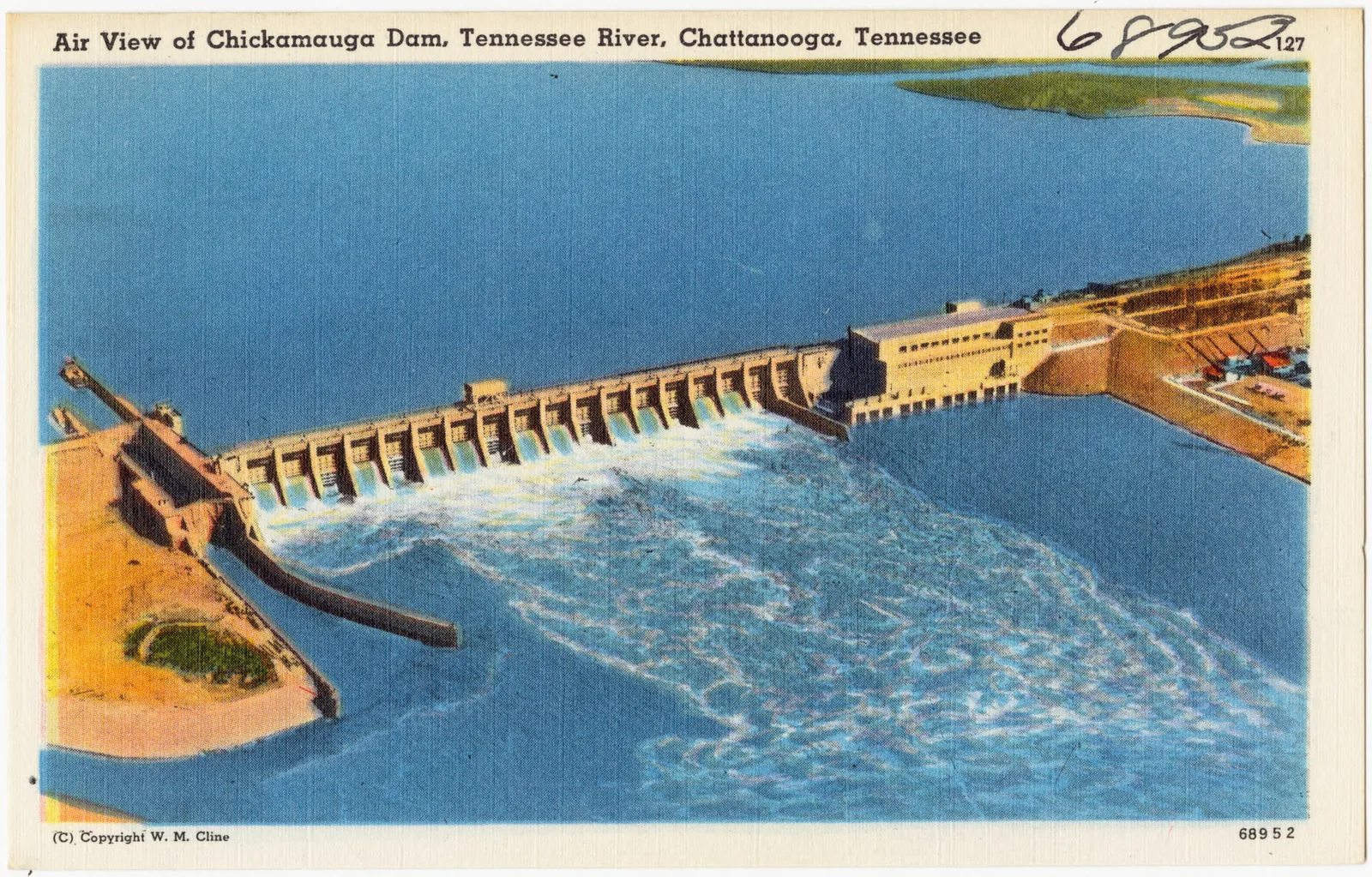
Chickamauga Dam
The project permanently rearranged Harrison.
Chattanooga had lived with destructive Tennessee River flooding for generations. When the Tennessee Valley Authority was created in 1933, flood control became one of the major goals of an interconnected system of dams and reservoirs.
Chickamauga Dam was authorized at the end of 1935. Construction began in January 1936, and the completed project was dedicated in 1940. [8]
TVA says the Chickamauga project required more than 61,000 acres. Across the entire reservoir project, more than 900 families were relocated, along with 24 cemeteries and 81 miles of roads. Those numbers apply to the whole reservoir, not Harrison alone. [8]
Harrison, however, was directly in the path of the water.
For Harrison Baptist Church, even the dead had to move. Graves were relocated to higher ground before the reservoir filled. Homes were removed or abandoned, families relocated, and Old Highway 58 was replaced by a new route on higher ground.[7]
Then the water came up.
The town is still down there
The lake covered Old Harrison. It did not erase every trace.
When Chickamauga Lake reaches lower seasonal levels, pieces of the former landscape can still become visible. Old roadbeds, foundations, sidewalks and building sites have been matched against historical maps. [7][17]
Modern archaeology is adding another layer. In 2026, University of Tennessee at Chattanooga researchers used remote-sensing equipment to survey submerged Old Harrison and the earlier Vann Town area. Researchers reported passing over the old road through town and detecting numerous building foundations. [9]
That changes the way I look at the lake. There really is another Harrison down there.
Not a mysterious lost city from a legend. A regular East Tennessee town with a restaurant, stores, a doctor's house, a church, a school, sidewalks, roads and homes.
Harrison Bay State Park
A new Harrison grew around the landscape TVA created.
Harrison Bay State Park traces its beginning to the same New Deal and TVA era. Tennessee State Parks recognizes Harrison Bay as the state's first state park, and the park developed around the new Chickamauga Reservoir shoreline with help from New Deal-era programs. [10]
The shoreline looks natural now because generations have grown up with it. It is not. It is the edge of a reservoir.
Places where people once lived became lakefront woods. River bottoms became coves. Former home sites became archaeological sites. The recreational landscape people know today grew from the same project that required other families to leave.
Harrison Bay is still one of the places that immediately feels like Harrison to me. Knowing the history does not make the park less enjoyable. It makes it more interesting.

Bay Point Loop was part of my mountain-bike world growing up. This ride was my first time back on the trail in at least 15 years.
Read the ride storyThe Harrison I grew up in
The woods filled the spaces between everything else.
By the time I came along, Chickamauga Lake was not new. It was simply part of Harrison. The town under the lake was old history, and the Harrison I knew had grown around Highway 58, the state park, schools, neighborhoods and miles of woods.
There was room. That is probably the biggest difference between the Harrison I remember and the one I see developing now.
The woods between Harrison Bay State Park and Birchwood Pike were basically part of our playground. We rode four-wheelers and dirt bikes through them. We squirrel hunted with pellet guns. We played around the lake. We spent time in the creeks, where one of our favorite things to do was pile up rocks, sticks, mud and whatever else we could find and try to dam the water.
There was no plan to it. We were just kids outside. That was normal.
Looking back now, those woods were not nearly as untouched as they seemed to us. People had been living, farming, hiding things and traveling through that land long before we got there. Sometimes we found the evidence.
The moonshine still
We found a piece of rural Harrison without realizing it.
One of those discoveries happened while we were playing in a creek. We started finding old pieces of metal just underneath the leaves and forest floor.
There was copper pipe. There were metal bands that had once wrapped around wooden barrels.
As kids, we decided we had found an old moonshine still. At the time, an abandoned still sounded a lot cooler than finding random old junk in the woods, so that was enough evidence for us.
Years later, I know a lot more about traditional moonshine operations than I did then. Looking back at what we found and where we found it, I am certain that we really had stumbled onto the remains of an old still site.
Everything fits. The site was deep enough in the woods to provide privacy. It was beside running water, which a traditional still operation needed. There were remnants of copper equipment and barrel bands.
Someone had operated a still in those woods, and enough time had passed that most of it had disappeared back into the ground.
We did not think of it as history. We looked at it, thought it was cool and kept playing. Now I wish I had paid a lot more attention.
The shack near the lake
Another childhood place carried a much darker story.
Far from the road and very close to the lakeshore was a small house. Honestly, a big shack might be a better description. Eventually it burned down.
At some point, we were told that many years before our time the building had been used as a meeting place for the Ku Klux Klan.
I have never found documentation tying that particular building to the Klan, so I do not want to turn something we were told into established history.
The broader history is real. UTC Special Collections preserves correspondence from Chattanooga Klan No. 4 from 1922 and documents Klan activity in the region. [16]
That does not prove anything about our shack. By the time I was growing up in Harrison, I personally did not know of Klan activity in the area where we lived and played. To us, it was simply an old building out in the woods.
The still and the shack are two reasons I think about those woods differently now. As kids, we saw wilderness. It was not. People had been there before us. Some of what happened there was ordinary. Some of it was illegal. Some of it may have been ugly. Most of it had already been forgotten.
Country, but close enough
Harrison felt separate from Chattanooga without feeling isolated.
The thing I remember most about Harrison was not any one building or landmark. It was how the place felt.
Harrison was country, but it was not way out in the middle of nowhere. Chattanooga was close. If you needed something you could not get locally, you drove toward town.
You could have land, woods, the lake and a rural lifestyle without living an hour from everything. At the same time, you knew when you had left Chattanooga.
Harrison did not feel like another Chattanooga neighborhood. It felt like Harrison.
Even internet service reinforced that separation. Some parts of the community waited a surprisingly long time for reliable high-speed service.
You were close to town. You just were not in town. That was part of the appeal.
Schools and the newer Harrison
The community's landmarks moved inland too.
As Harrison shifted away from the old town site, schools became some of the most recognizable landmarks along Highway 58.
Central High School began on Dodds Avenue in Chattanooga. The school moved to its Highway 58 campus in Harrison in 1969.[11]
J.B. Brown Junior High opened beside it for the 1967-68 school year and later became Brown Middle School. [12]
Along with Harrison Elementary, those schools became part of how generations of local families mentally mapped Harrison.
Old Harrison had centered around a courthouse and compact business district near the river. The Harrison I knew was more spread out. Highway 58 became the spine. Schools, churches, stores and neighborhoods spread along it and down the roads branching away from it. The lake was nearby, and the woods filled a lot of the space in between.
Over time, those spaces have gotten smaller.
How much has Harrison grown?
The official population number does not tell the whole story.
The Harrison census-designated place had 7,769 residents in 2010 and 7,902 in 2020. That is an increase of only 133 people.[13]
At first glance, that does not sound anything like the growth longtime residents talk about.
The problem is that the Census definition of Harrison and the Harrison people talk about locally are not exactly the same thing. Development outside the CDP boundary can still be part of what locals think of as Harrison, and those homes still put vehicles on Highway 58 and Birchwood Pike.
Hamilton County's Area 9 planning work acknowledges both the area's rural character and the development pressure around Harrison. In the planning survey, 92 percent of respondents reported some peak-hour congestion, 88 percent identified roads as the top infrastructure need, and 96 percent said they wanted to preserve farmland, rural character, wooded areas, steep slopes and land along waterways. Those figures cover the broader Northeast County planning area, not Harrison alone.[1]
They still sound familiar to anyone who has listened to longtime Harrison residents talk about growth.
The growth is not just a feeling
Large subdivisions are appearing in the same landscape.
In May 2023, the Regional Planning Commission approved a preliminary plat for Hamilton Lakes, a proposed 195-lot subdivision in County Commission District 9. [14]
Planning records later show a 61-lot final plat for Hamilton Lakes at 10008 Birchwood Pike in November 2024.[15]
That is one development. It does not explain every change in Harrison, and it would be unfair to blame one subdivision for everything longtime residents dislike about growth.
But 195 proposed lots are also not something you fail to notice in a place where woods and open land are part of the community's identity.
It happens piece by piece. A property gets cleared. A subdivision appears. Another road gets busier. More houses create demand for more businesses. More businesses make the area more convenient. More convenience makes the area attractive to more people.
My view of Harrison todayIt is too busy, and there are too many people.That is subjective, but it comes from remembering a version of Harrison where woods and open land were part of everyday life.
Why people keep coming
The things that make Harrison desirable can also change it.
Someone moving into Harrison today may see a great place to raise a family. They are close to Chattanooga. Harrison Bay is right there. Chickamauga Lake is right there. There are still wooded areas, rural roads and opportunities to own more property than they might have in the city.
In other words, they probably like Harrison for many of the same reasons my family did.
I do not blame anyone for wanting to live there. People need houses. Landowners have property rights. Businesses need customers. New residents become part of the community just like previous generations did.
Growth is not automatically bad, but it does not come without a cost. When you grew up looking at woods and later see houses there, you notice. When a country road becomes busy, you notice. When subdivisions fill the spaces that used to separate neighborhoods, you notice.
Enough people wanting Harrison's rural character eventually puts pressure on the exact things that attracted them.
Harrison never really stayed the same
The version I grew up in was already the result of earlier changes.
It would be easy for me to write this as if the Harrison I grew up in was the correct version of Harrison and everything happening now is ruining it.
That would not be fair, and it would not fit the history.
Cherokee people lived here before the American town existed. They were forced from the land. Harrison became a county seat. The Civil War came through it. The railroad helped Chattanooga pass it by. Harrison lost the county seat. It became part of a new county and lost another county-seat fight by one vote.
It came back to Hamilton County. James County disappeared. TVA arrived. Old Harrison went underwater. A state park developed around a shoreline that had never existed before. Roads moved. Schools moved. Homes spread farther inland.
The rural Harrison I grew up in was itself the result of all those earlier changes.
Now another version is forming. That does not mean I have to like all of it. It just means Harrison has never been as permanent as it seemed when I was a kid.
What still feels like home
Some places do not have to stay physically unchanged to stay yours.
The family property north of Wolftever Bridge is one of those places for me.
The property itself has been completely redone, but my parents and brother are still there. I still make the same drive back into Harrison. The roads are familiar. The lake is familiar. There are still stretches of woods where Harrison looks a lot more like the place I remember.
Harrison Bay is another one. That is part of why going back and riding the Bay Point Loop by e-bike for KAPPIN RIDES was interesting for me.
I was not really discovering Harrison Bay. I was riding through somewhere that had always been part of home.
What has changed is how much I know about what I am looking at. I know there was another town under some of that water. I know people once traveled roads that now disappear into Chickamauga Lake. I know Civil War earthworks survive on an island I probably would not have thought twice about as a kid. I know the woods we played in contained the remains of an old moonshine operation.
The Harrison I knew as a kid had history everywhere. I just did not know to look for it.
Quick answers
Harrison history FAQ
Was Harrison really Hamilton County's county seat?
Yes. Harrison became the county seat in 1840. Hamilton County government moved to Chattanooga in 1870.[3][4]
Is Old Harrison really underwater?
Yes. Much of the old town site was inundated when Chickamauga Reservoir filled. Foundations, old roads and other remnants can still be identified, particularly at lower seasonal water levels. [7][9][17]
Was Harrison part of James County?
Yes. Harrison became part of James County when it was created in 1871 and returned to Hamilton County in 1893. James County itself was abolished in 1919.[1][4]
Why did TVA flood Old Harrison?
Harrison was inside the future Chickamauga Reservoir pool. TVA built Chickamauga Dam as part of a regional system for flood control, navigation, power generation and river management. [8]
Is Harrison growing quickly?
The official Harrison CDP grew only modestly from 2010 to 2020, but the broader Harrison and Northeast County area has continued to see subdivision activity and development pressure. Local planning surveys show strong concern about traffic, roads and preserving rural character.[1][13][14][15]
Why Harrison's story is worth telling
Every generation gets a different Harrison.
There was a Harrison before Chickamauga Lake.
There was a Harrison before Highway 58 became the road we know today. There was a Harrison with a courthouse. There were merchants, a church, a school, a doctor's house and a little cluster of businesses. There was even a place called the Green Fly Restaurant.
There were roads that do not exist anymore because Chickamauga Lake is sitting on top of them.
Then there was the Harrison I knew. That Harrison was four-wheelers and dirt bikes. It was squirrel hunting with pellet guns. It was building dams in creeks. It was wandering through woods between Harrison Bay and Birchwood Pike. It was finding pieces of an old moonshine still buried beneath the leaves without understanding that we were holding pieces of local history.
Someone growing up in Harrison today is going to remember a different place. Their Harrison will have more houses, more subdivisions, more traffic and definitely better internet.
Fifty years from now, they may look around and wonder what happened to the Harrison they remember.
Harrison has never really stopped changing. Sometimes the change came from politics. Sometimes it came from railroads. Sometimes it came from war. Sometimes the federal government built a dam and put part of the town underwater.
Today the change is slower. It comes one road, one subdivision, one cleared piece of woods and one new family at a time.
The old Harrison is still down there beneath Chickamauga Lake. The Harrison I grew up in is still there too, at least in pieces. You just have to know where to look.