
Start here
What exactly is a Joro spider?
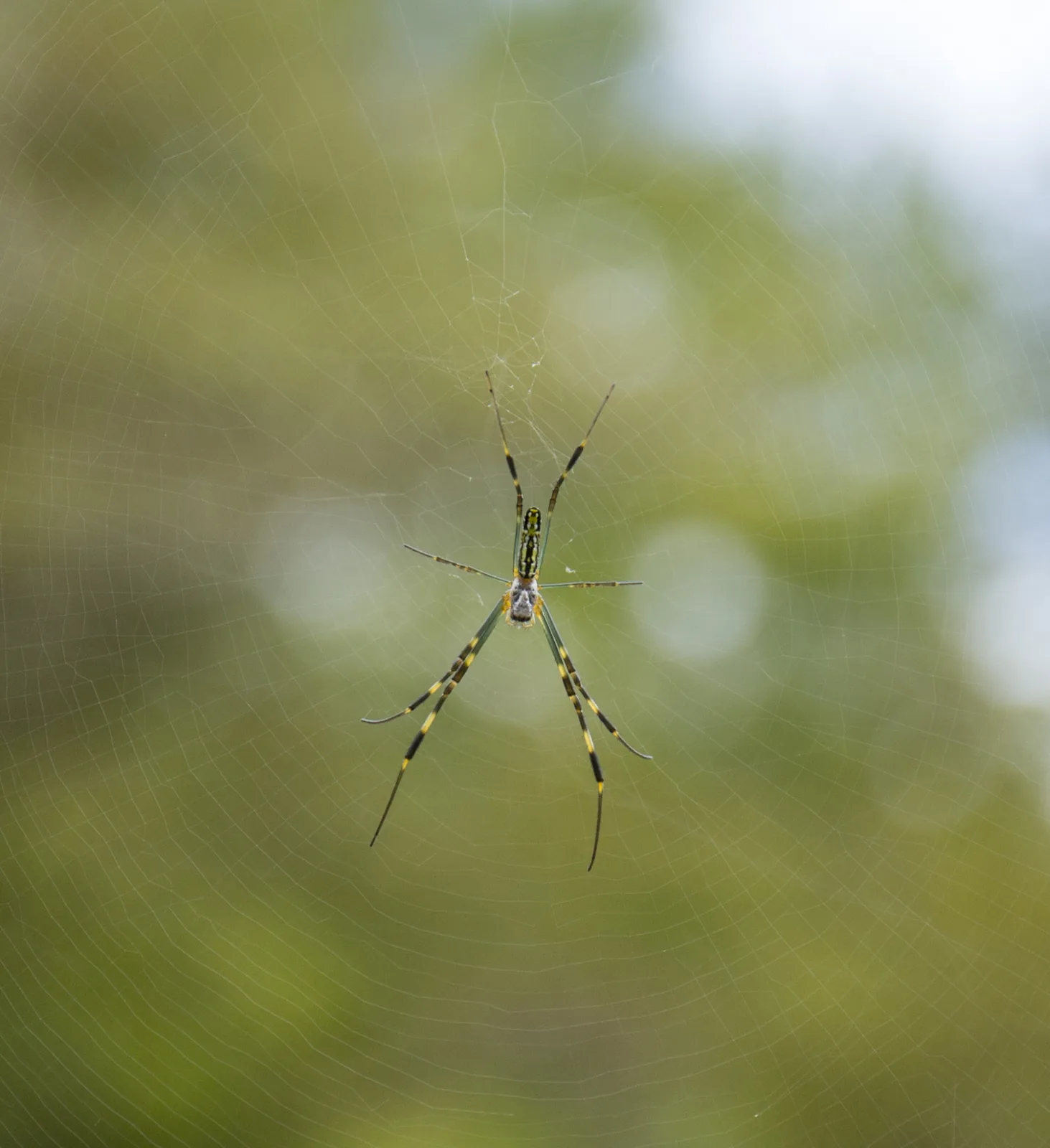
The Joro spider, Trichonephila clavata, is a large orb-weaving spider native to East Asia. The first confirmed North American specimens were collected in northeast Georgia in 2014, although later work suggests the population may have been present for several years before anyone formally recognized it. [1][2][6]
Today, University of Georgia Extension lists Joros as established in Georgia, North Carolina, South Carolina, Tennessee, and Alabama, with isolated populations farther north. In other words, seeing one around Chattanooga or elsewhere in Tennessee is no longer a freak occurrence.[1]
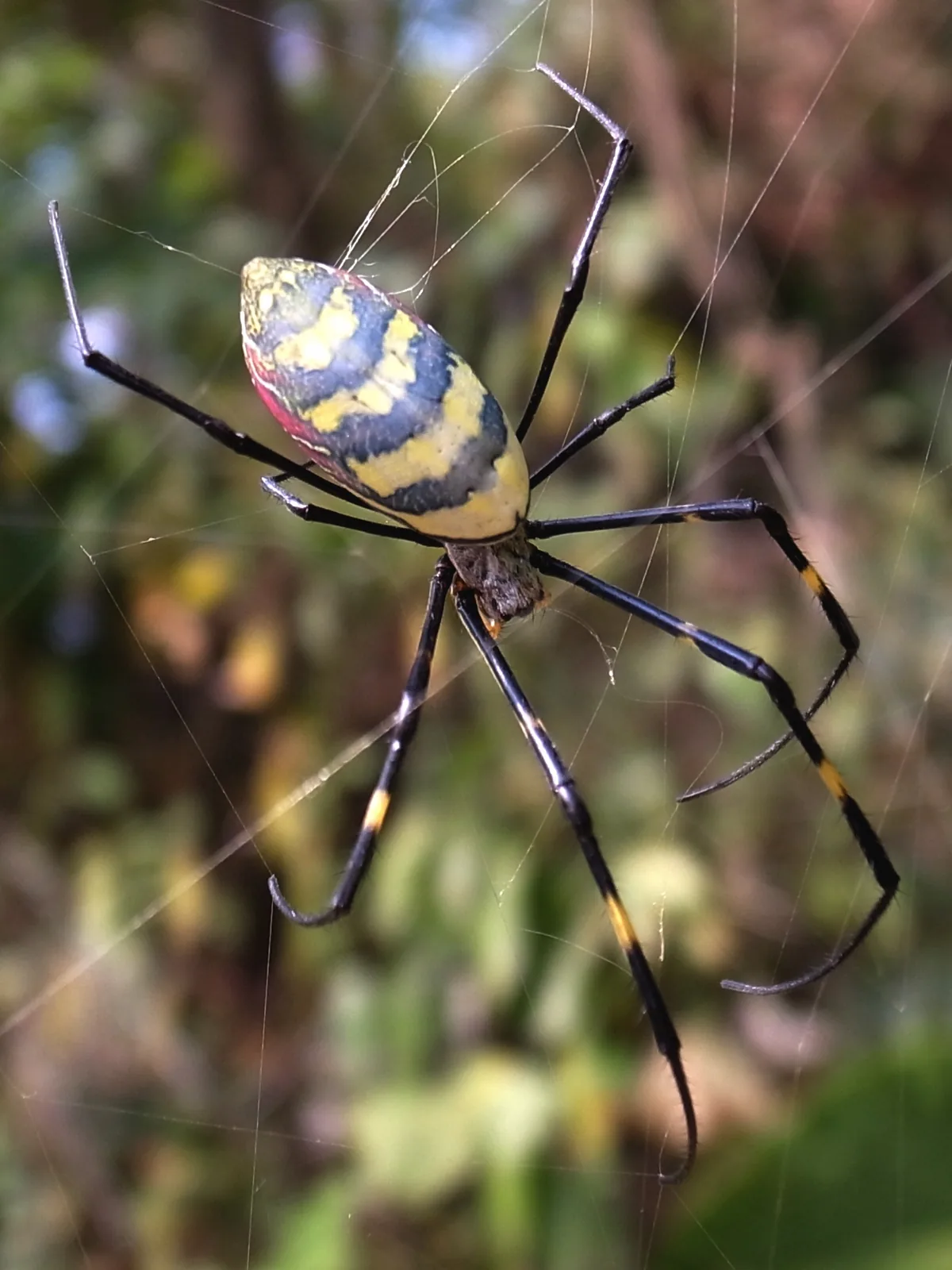
The adult female is the one everyone notices: bright yellow markings, blue-green and black coloration, red around the underside of the abdomen, long banded legs, and a huge golden-silk web. Males are dramatically smaller and far less colorful. Mature female webs can span 10 feet or more, with support strands stretching even farther between trees and structures. [9]
Their life cycle is annual in this region. Eggs overwinter, hatch in spring, juveniles grow through summer, and adults become conspicuous in late summer and fall. [1][9]
The useful correction is not“Joros are harmless.”It is“Human danger and ecological impact are different questions.”
Arrival & spread
How did they get here?
Nobody watched the first Joro step off a ship, so the exact introduction route is not known. The leading explanation is accidental transport with international cargo or other human commerce from Asia. Researchers have described that scenario as the most likely origin of the U.S. population, while acknowledging that the introduction itself was never directly observed. [2][6]
Once here, they did what spiders are very good at doing: spreading. Young Joros can disperse by ballooning, releasing silk that lets air currents carry them away from their starting point. Reviews of the invasion conclude that natural dispersal is an important part of their regional expansion, while hitchhiking on vehicles and transported material can also move them farther than they would travel naturally. [3]
Tiny juveniles can balloon. That does not mean giant adult females are taking off and flying through neighborhoods. “Flying Joro spiders” is a dramatic description of a normal spider dispersal behavior performed when they are small.[3]
Human risk
Are Joro spiders dangerous?
Their size makes this question feel more urgent than the evidence says it is. UGA Extension describes Joros as very timid and reports that their first response to people is usually to retreat. Extension researchers also report no bites even during fairly rough handling while collecting specimens. [9]
A controlled behavior study adds an even stranger detail. Researchers compared 453 startle observations across 10 spider species. Most spiders resumed activity within about a minute after a mild puff of air. The two Trichonephila species tested, including Joros, commonly remained motionless for more than an hour. That is not proof that a spider can never defend itself, but it is strong evidence against the picture of an unusually aggressive animal. [5]
Like almost all spiders, Joros use venom to subdue prey. “Venomous” and “dangerous to people,” however, are not the same claim. Current Extension guidance treats accidental contact as a nuisance issue, not a major public-health threat. A bite from any spider or animal can still hurt, become irritated, or deserve medical attention if a serious reaction develops. [9]
Cold tolerance
Winter probably will not stop them.
Joros attracted attention partly because their U.S. range began in the Southeast, which raised the obvious question: would colder winters put a hard northern limit on them?
A 2022 physiology study compared Joros with the already established golden silk spider. Joros had roughly twice the metabolic rate, maintained a 77% higher heart rate during cold exposure, and 74% survived a brief below-freezing lab trial versus 50% of the golden silk spiders. The freezing portion of that experiment lasted only about two minutes, so it should not be translated into “Joros can survive any winter.” It does show meaningful cold tolerance.[4]
A separate species-distribution study reached a compatible conclusion from a different direction: climate models using the spider's native Asian range predicted suitable North American habitat north of the early U.S. invasion zone, and the observed spread was faster northward than southward at the time of that analysis. [6]
Food web
What are they actually eating?
Joros are generalist web predators, not precision mosquito machines and not specialists that only eat “bad bugs.” Researchers using DNA metabarcoding on prey remains, fecal samples, and gut contents detected a wide range of arthropod groups. Their webs capture beetles, flies, true bugs, hymenopterans, moths and butterflies, other spiders, and additional prey. [7]
That broad diet is exactly why simple labels like “beneficial” or “harmful” are unsatisfying. A Joro can catch an agricultural pest one hour and a pollinator the next. UGA's current landscape guidance specifically advises against allowing dense webs around pollinator gardens and bee hives. [7][9]
The big unanswered question
What are they doing to native species?
This is where the story has changed the most. Early public discussion often swung between two extremes: Joros were going to wreck the ecosystem, or Joros were basically harmless. Researchers reviewing the evidence explicitly warned against both sensationalizing their impact and prematurely declaring them ecologically harmless. [3]
A 2023 field study found Joros were the most abundant orb-weaver encountered in its survey and found lower native orb-weaver richness and diversity closer to the area where Joros had been established longest. The authors also noted an important complication: human population density was entangled with the pattern, making simple cause-and-effect conclusions difficult. [6]
Then a 2025 three-year census of 25 Atlanta-area forest sites documented a striking concurrent trend. Joro counts rose from 444 in 2022 to 859 in 2023 and 1,713 in 2024, while native orb-weaver counts fell from 52 to 32 to 18. The study describes the pattern as concerning and consistent with possible ecological disruption. [8]
But the same paper is careful about causation: the study did not have pre-Joro baseline counts for those forests, and other unmeasured factors could have contributed to the native spider decline. So the defensible conclusion is not “Joros are destroying native spiders.” It is that there is enough evidence of a concerning association to justify serious, continued monitoring. [8]
Great Smoky Mountains National Park
In the Smokies, leave Joros alone and report them.
Great Smoky Mountains National Park has a specific request for visitors who find a Joro spider inside the park: do not kill it or disturb it. In an August 18, 2026 visitor notice, the park asked people to document sightings instead so University of Tennessee researchers can map the spider's spread and study what its expansion means for the region.[10][11]
The park's guidance is also consistent with its broader wildlife rules. Great Smoky Mountains National Park states that feeding, touching, teasing, frightening, or intentionally disturbing wildlife is illegal. In other words, an invasive label is not permission to start removing wildlife inside a national park. [12]
- Leave the spider and its web where you found them.
- Take a clear photograph and record the exact location of the sighting.
- Submit the observation through the free iNaturalist app or website.
- You can also send the sighting to University of Tennessee researchers at UTKJoroProject@utk.edu. [10][11]
The local timeline is still remarkably recent. The park's first confirmed Joro was documented on October 17, 2024, just west of Hyatt Lane in Cades Cove. That makes visitor reports especially useful: researchers are watching an invasion unfold in real time rather than reconstructing it decades later. [13]
This park-specific guidance is different from deciding what to do with a web on your own porch or walkway. Inside Great Smoky Mountains National Park, the best move is simple: photograph it, report it, and leave it alone.
Around the house
So should you kill them?
There is no science-based reason to panic-spray an entire yard because a Joro exists there. UGA Extension recommends a more targeted approach: remove spiders and webs where people are forced into contact with them: porches, doorways, walkways, and similar spaces, and avoid allowing webs around pollinator gardens or bee hives. Spiders in out-of-the-way parts of the yard can simply be left alone if you are comfortable with them. [9]
Broad insecticide spraying and fogging can kill pollinators, beneficial predators, and other non-target insects too. Extension guidance therefore favors direct, localized management over turning the entire yard into a treatment zone. [9]
That middle ground fits the evidence pretty well: enjoy the spider if it is in a harmless spot, move or remove it when the web is a practical problem, and do not confuse “not a major threat to humans” with “we already understand every ecological consequence.”
The takeaway
They deserve curiosity more than panic.
Joro spiders are almost engineered to become clickbait. They are huge, brilliantly colored, non-native, capable of ballooning when young, and spreading into new states.
But the most interesting version of the story is the one the research is actually telling. They appear unusually timid. They tolerate cold better than a related southern species. They are becoming a normal part of fall in parts of the Southeast. And scientists now have legitimate reasons to study what their enormous numbers may mean for native orb-weavers and insect communities. [4][5][6][8]
The monster story was too simple. The ecology story is still being written.