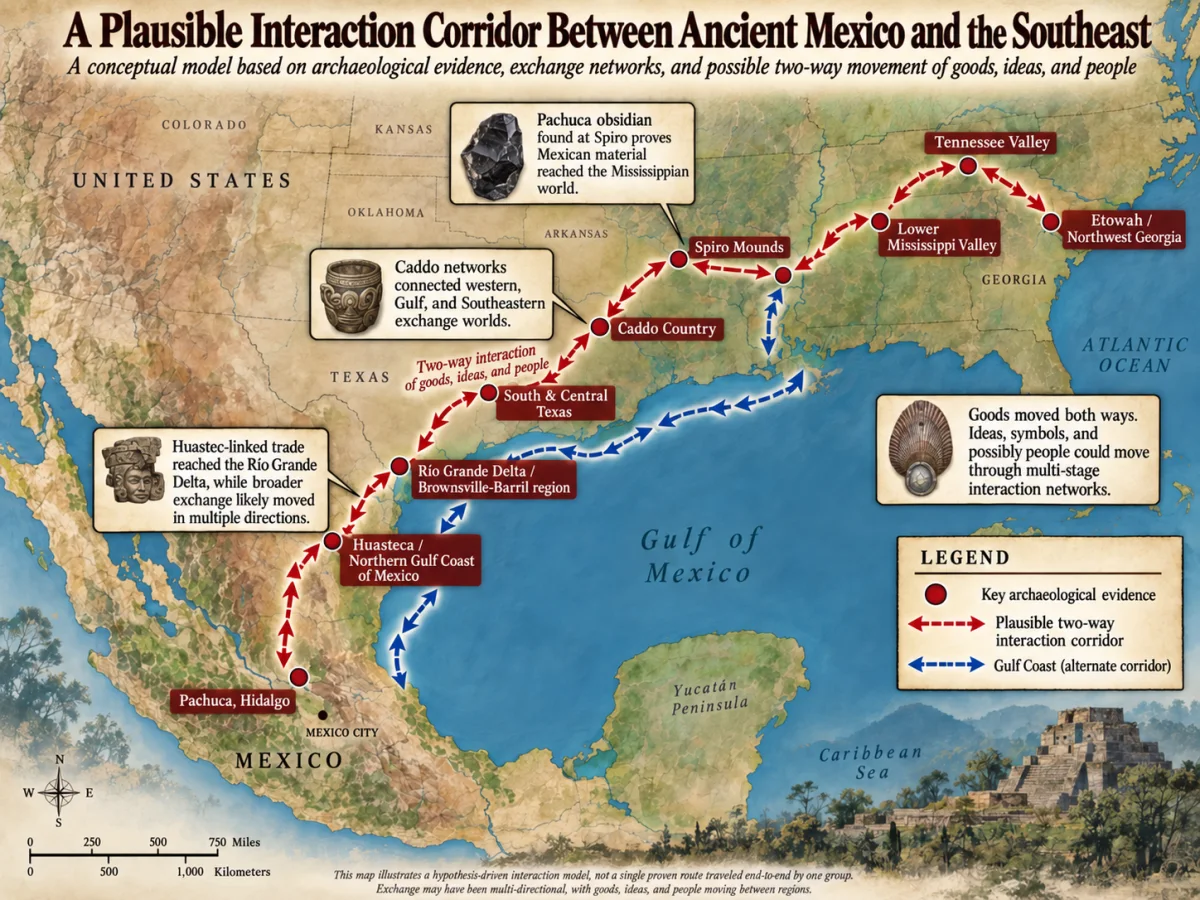
Start with the map in your head
Ancient America was not a collection of isolated worlds.
Most of us learned ancient American history in neat geographical sections. The Maya and other Mesoamerican civilizations were in Mexico and Central America. Mississippian cultures were in the southeastern United States. Woodland cultures came before them.
That framework is useful, but it can make ancient America seem far more divided than it really was. Copper, shell, mica, stone, pottery, obsidian, crops, ceremonial objects, and other goods moved across Indigenous exchange networks spanning enormous distances. Caddo country alone connected several major cultural regions, and the National Park Service notes that those networks moved ideas and influences along with physical goods. [8]
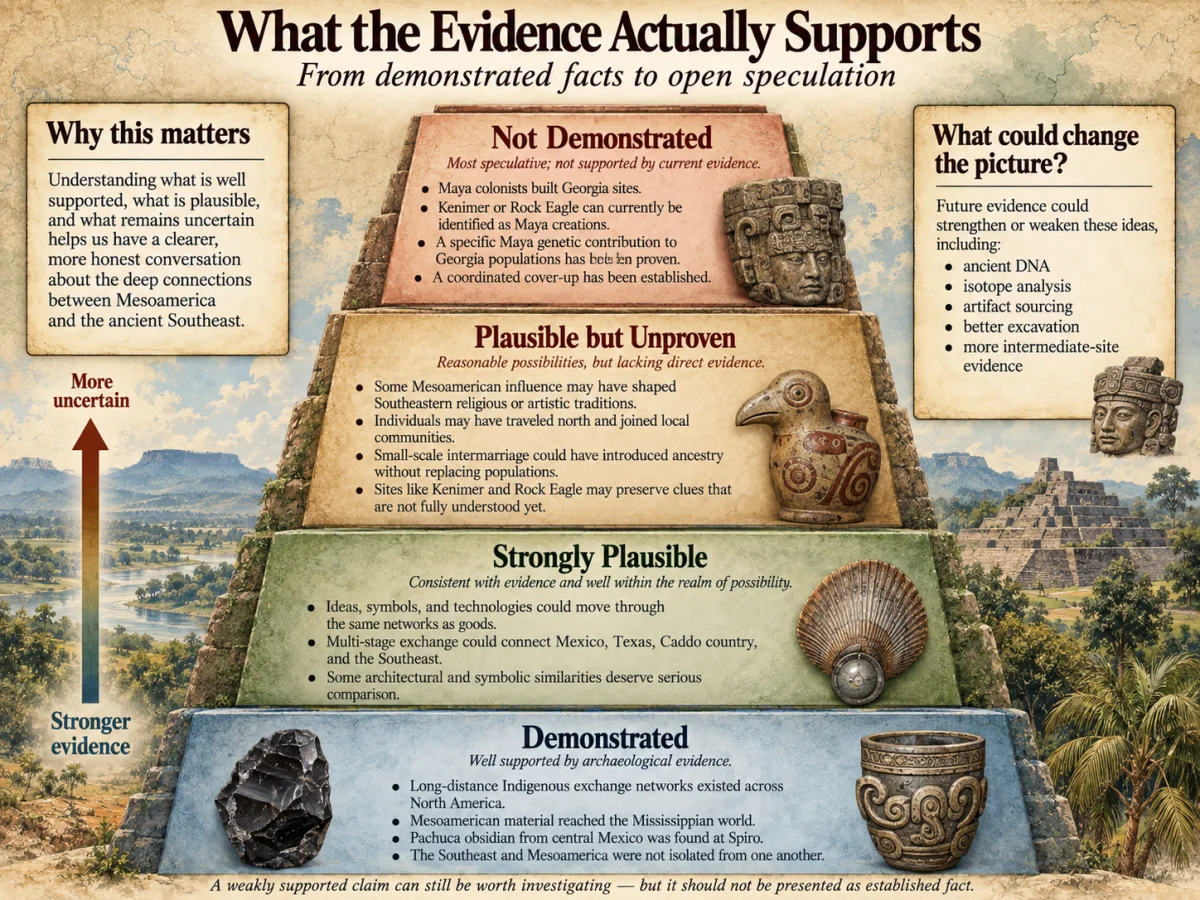
Even more important for this story, an artifact recovered at Spiro Mounds in Oklahoma was chemically traced to an obsidian source in Pachuca, Hidalgo, Mexico.[2]
Some connection between ancient Mexico and the broader Mississippian world is not hypothetical. The material got there. The mystery is how much else traveled with it.
Local roots matter
The Southeast already had ancient monumental traditions of its own.
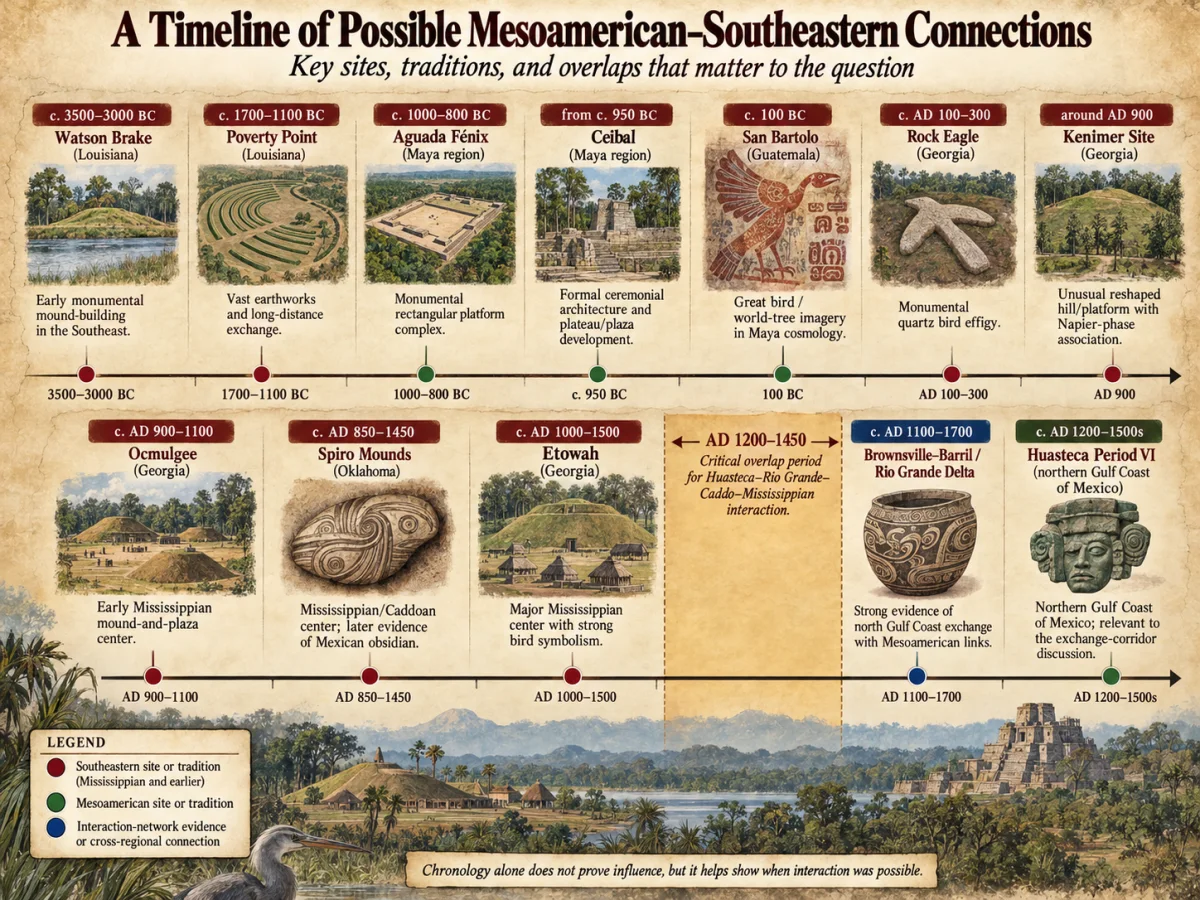
At Watson Brake in Louisiana, Indigenous people began constructing earthworks around 3500 BC, with substantial mound building underway by about 3350 BC. [1]
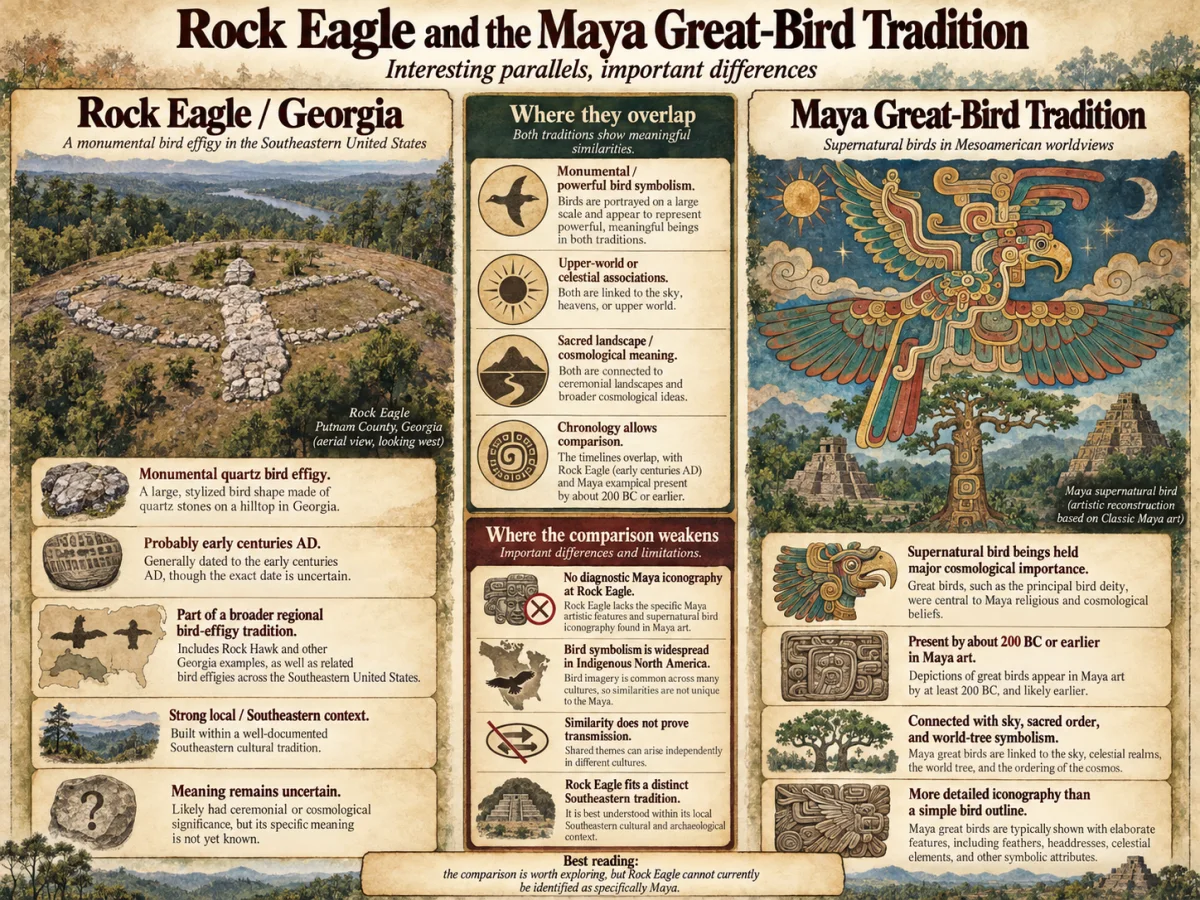
That immediately rules out one simplistic version of the Maya influence theory. Mesoamerica did not introduce mound building to the Southeastern United States. The Southeast had monumental earthwork traditions thousands of years before Classic Maya civilization.
By the Mississippian period, places such as Ocmulgeeand Etowah had become major ceremonial centers organized around platform mounds, plazas, important buildings, and complex religious and political systems. [16][17]
If outside ideas reached these societies, they were reaching cultures with long histories of their own. That makes cultural interaction a much more realistic model than cultural replacement.
The artifact that changes the conversation
The Spiro obsidian proves the distance was crossed.
Obsidian is volcanic glass. Different volcanic deposits have distinctive chemical signatures, which lets researchers compare an artifact with known geological sources.
The Spiro scraper was analyzed using X-ray fluorescence and traced to Pachuca in central Mexico. The researchers described that source identification as extremely secure and identified the piece as the first documented Mesoamerican material from a Mississippian archaeological context in the pre-Columbian southeastern United States. [2]
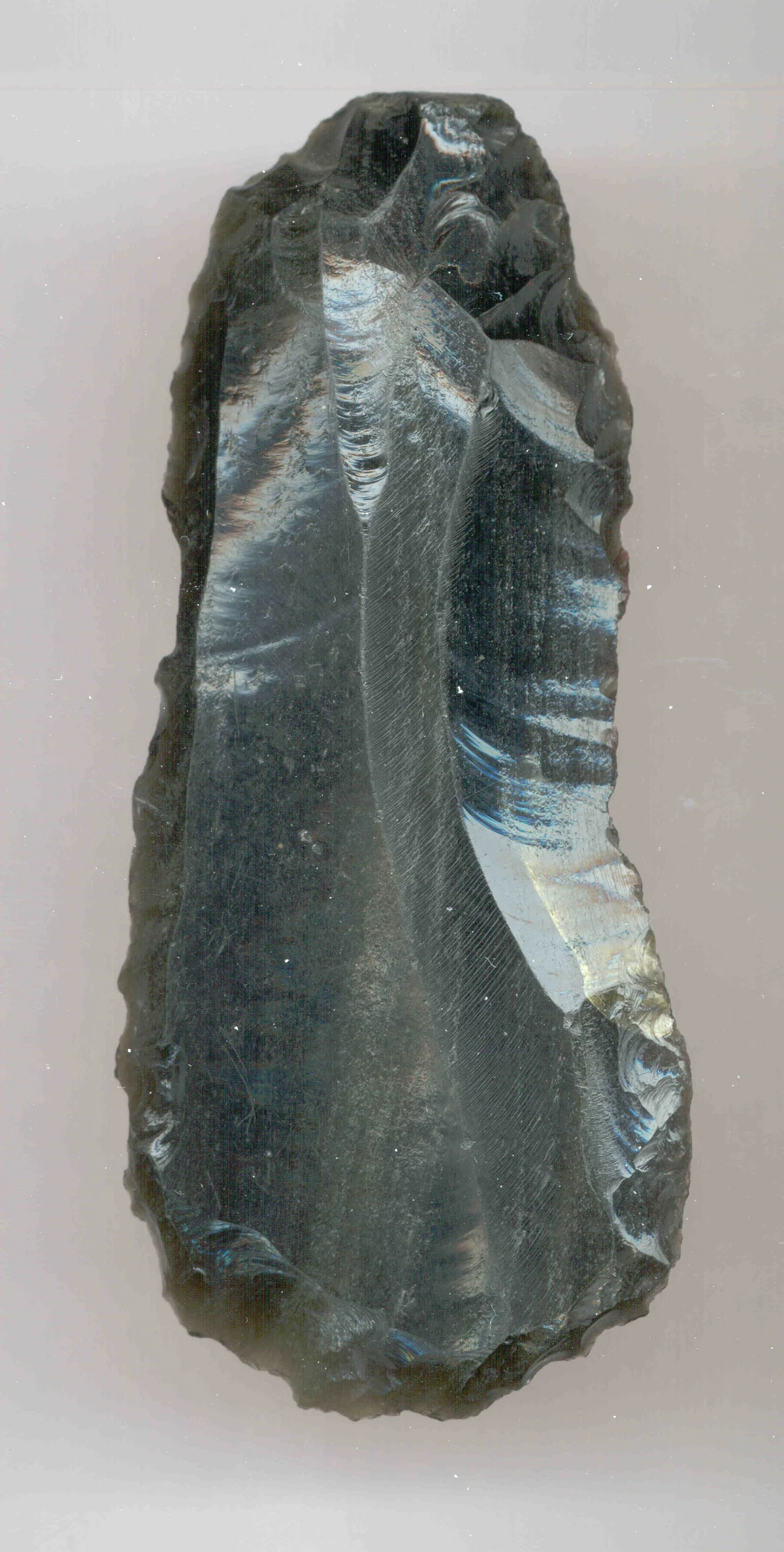
Maybe one person carried it a remarkable distance. Maybe it changed hands repeatedly. Maybe it entered Texas exchange networks, reached Caddo territory, and eventually arrived at Spiro. We do not know.
What we do know is simpler: the distance was crossed. That turns “could Mexico have been connected to this world?” into “how extensive were the connections?”
Not a fringe starting point
Archaeologists have studied a Mexico-Southeast connection for decades.
Archaeologists Nancy Marie White and Richard Weinstein noted that New World archaeologists have long agreed prehistoric cultural interaction occurred between Mesoamerica and the southeastern United States, even though the routes, frequency, and importance remain difficult to reconstruct. Their review favors sporadic long-distance interaction rather than a constant Mesoamerican presence in the Southeast. [3]
Their work is useful for another reason: it does not treat influence as automatically moving north. They also examine Southeastern cultural traits extending westward toward Texas.
That suggests a better model than “Mexico influenced the Southeast.” Different Indigenous societies may have influenced one another across a broad interaction zone.
The geography gets smaller
The Huastec bring the Mayan language family much farther north.
The Huastec, or Teenek, occupied part of Mexico's northern Gulf Coast. Teenek belongs to the Mayan language family, although Huastec society developed separately from the better-known Maya civilizations farther south. [4][5]
This does not make the Huastec interchangeable with the Classic Maya. It does matter geographically. A Mayan-language population lived much closer to Texas and the northern Gulf Coast than the famous cities of Guatemala and the Yucatán.
Gordon Ekholm of the American Museum of Natural History originally planned archaeological work northward toward Texas in part to investigate possible connections between Mesoamerica and the Southeastern United States. His Huasteca research eventually focused around Tampico and Pánuco, but the question itself was already on archaeologists' minds decades ago. [5]
A real two-way exchange zone
The Rio Grande Delta was trading with Mexico in both directions.
The Brownsville-Barril complex represents Indigenous communities around the Rio Grande Delta during roughly AD 1100 to 1700. Archaeologists have recovered pottery from the Tampico region, Mexican jadeite, and obsidian from central Mexican sources in this area. [6]
Just as important, shell tools and ornaments from the Rio Grande Delta traveled south into northeastern Mexico. This was not simply Mexico sending objects north. It was exchange. [6]
Mexican obsidian also reached Texas much earlier than the Late Prehistoric period, while other obsidian moved into South Texas from sources far to the north and west. [7]
The middle is populated
Caddo country helps turn one giant leap into overlapping networks.
The Caddo occupied an important crossroads where southeastern woodlands met western prairies. National Park Service research describes exchange routes connecting Caddo communities with the Southeast, Cahokia, the Southwest, and Rio Grande Pueblo communities. Gulf shell, Great Lakes copper, Appalachian mica and marble, and Ozark minerals all moved through these networks. [8]
The Caddo were not passive middlemen. They were societies with their own political, economic, and ceremonial systems. They received, reworked, and transmitted culture.
Instead of imagining a direct Mexico-to-Georgia trip, picture overlapping regions:
Mesoamerica ↔ Huasteca ↔ northeastern Mexico ↔ Rio Grande Delta ↔ Texas ↔ Caddo country ↔ Mississippi Valley ↔ Southeast
No single traveler has to cover that entire distance for an object or idea to do it.