
First, the obvious question
Is it actually smoke?
Usually, no.
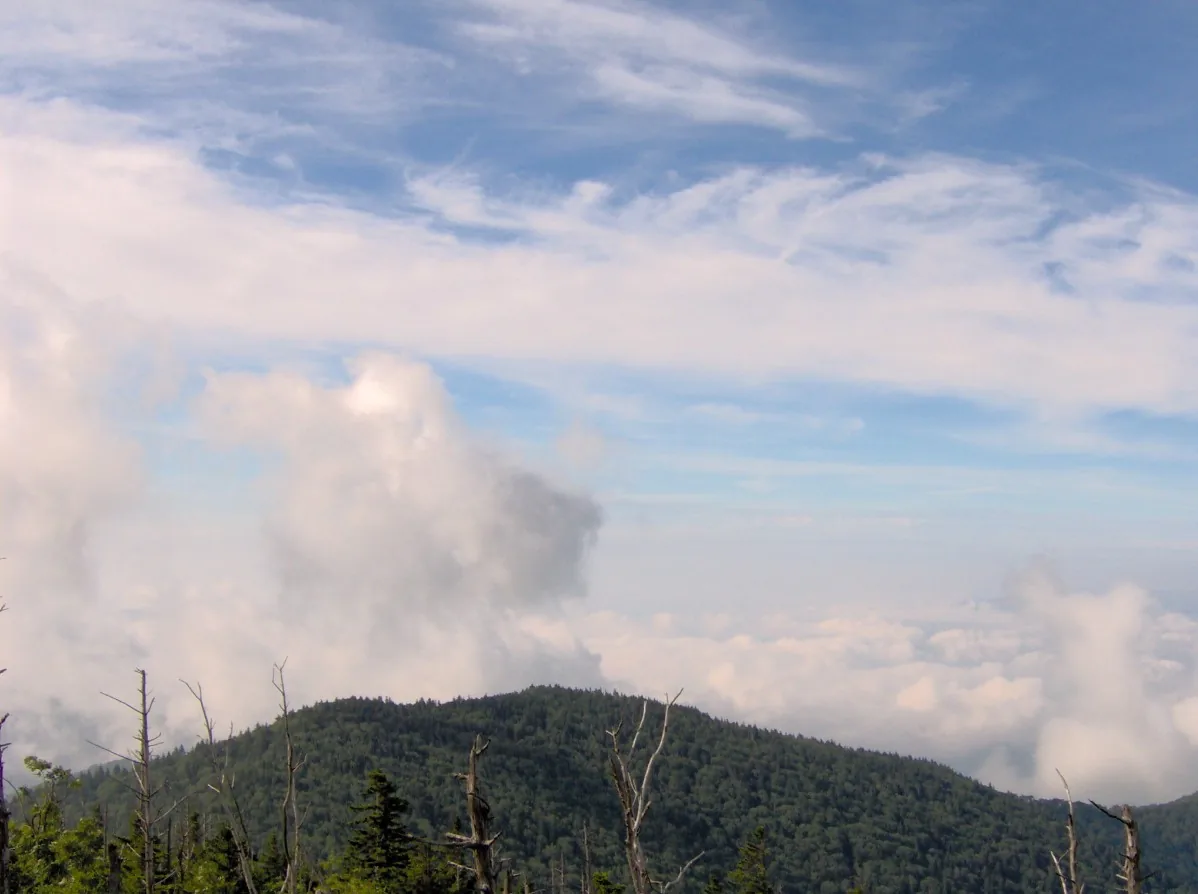
When you look across several ridges in the Great Smoky Mountains and see that soft blue-gray layer hanging in the distance, you are usually looking at a mix of natural haze, moisture, and sometimes actual fog or low cloud. The signature blue haze is not the result of the mountains quietly burning all day. [1][6]
The part I always found interesting is that saying "it is mist" is not really the full answer either. The forest is actively helping create the haze.
Roughly 95 percent of Great Smoky Mountains National Park is forested. All of that plant life is constantly exchanging gases and moisture with the atmosphere. [1]
The simple versionThe forest breathes.The atmosphere does chemistry with what comes out.We see the result as blue haze.
The chemistry
Trees release gases you cannot see.
Plants release natural chemicals called volatile organic compounds, usually shortened to VOCs. In forests, scientists often call them biogenic VOCs because they come from living things instead of factories, fuel tanks, or exhaust pipes.
Isoprene and monoterpenes are two important groups of these compounds. Research in southeastern U.S. forests has measured substantial emissions of both, with tree species and canopy structure affecting how much gets released. [7]
Those gases do not just sit there. Once they enter the atmosphere, they react with other chemicals. Some of the reaction products can condense into extremely small airborne particles known as secondary organic aerosols. Forest-generated aerosols are a real, measurable part of atmospheric chemistry, not a poetic explanation somebody came up with for tourists.[6][8]
Isoprene, terpenes, and other natural compounds enter the air.
Sunlight and atmospheric oxidants transform those gases.
Some reaction products become tiny suspended aerosols.
The particle-filled air takes on the familiar blue haze.
Why blue?
The haze changes the way sunlight reaches your eyes.
Sunlight looks white, but it contains the colors of the visible spectrum. Tiny molecules and particles in the atmosphere scatter different wavelengths of that light differently.
NASA's explanation of the Smokies describes the aerosols produced from plant VOCs as scattering shorter wavelengths near the blue-violet end of the spectrum. The National Park Service gives the same basic explanation for the park's famous bluish haze. [1][6]
Distance makes the effect more obvious. When you look across ridge after ridge, you are looking through more atmosphere. More scattered light gets mixed into what your eyes receive from those distant mountains, reducing contrast and giving far ridges that layered blue appearance.
That is why a nearby ridge can look dark green while the next few ridges fade from blue to almost gray as they disappear toward the horizon.
The moisture factor
The Smokies are also just really wet.
This is not a dry forest making haze in a vacuum. The Great Smoky Mountains are part of a temperate rainforest system, with the National Park Service reporting about 55 inches of annual precipitation at lower elevations and around 85 inches at higher elevations. [3]
Warm, moist air is pushed upward by the mountains. As it rises, it cools and water condenses into clouds and fog. Plants also release water vapor. Put all of that together and you get an atmosphere that is already primed to look hazy. [1]
Humidity can also make airborne particles scatter more light, which means the same landscape can look dramatically hazier on one day than another. [9]
So when you see tendrils of white fog pouring through a gap, that may literally be cloud. When the whole chain of ridges carries a blue cast on an otherwise clear day, the natural aerosol haze is doing more of the visual work. A lot of the time, you are seeing some combination of both.
Natural haze vs. pollution
Not all haze over the Smokies is the good kind.
This part matters because the mountains had their blue haze long before power plants, highways, and modern industry. But human-caused pollution can add a second kind of haze on top of the natural one.
The National Park Service says the natural haze is typically blue and mist-like. Pollution-related haze tends to look more uniform and whitish, and it can dramatically reduce how far visitors can see. Sulfates, organic compounds, soot, dust, and other fine particles all contribute to visibility loss.[4][5]
The park has documented major visibility improvements since the 1990s as regional air pollution controls improved, but human-caused haze is still a problem. NPS air-quality data say pollution can reduce average natural visual range from roughly 110 miles to around 60 miles, with much shorter ranges on bad summer days. [4]
That gives us an important distinction: the Smokies are naturally smoky, but they are not naturally smoggy.
Part of the landscape for centuries. Usually blue-gray, soft, and layered across distant ridges.
Often more whitish and uniform. It reduces visibility and can also damage ecosystems and affect human health.
The name came first
People noticed the blue smoke long before the national park existed.
The National Park Service says the Cherokee referred to these mountains as Shaconage, commonly translated as "land of blue smoke" or "place of the blue smoke."[1][2]
That matters because it rules out the idea that the look is some modern side effect that gave the mountains their name. The visual character was part of this landscape long before the park was established in 1934 and long before modern industrial air pollution. [1]
The chemistry explanation came later. The observation did not. People have been looking at these ridges and seeing blue smoke for a very long time.
Watch it
Why Are the Smoky Mountains Actually Smoky?
I made the short video version first. This Library article is the deeper version with the sources, the atmospheric chemistry, and the distinction between the Smokies' natural blue haze and pollution haze.
Quick answers
Smoky Mountains haze FAQ
Are the Smoky Mountains actually smoking?
Usually no. The signature "smoke" is natural haze, moisture, fog, and cloud. The blue haze is strongly tied to plant-emitted VOCs that react in the atmosphere and form tiny particles that scatter light. [1][6]
What do trees have to do with the blue haze?
Trees and other plants release biogenic VOCs including isoprene and monoterpenes. Atmospheric reactions turn some of those compounds into secondary organic aerosol particles, which contribute to the visible haze.[7][8]
Why does the haze look blue?
Tiny particles and molecules scatter sunlight. The natural aerosol haze in the Smokies preferentially contributes to scattering in the blue-violet part of the visible spectrum, giving distant ridges their familiar blue cast.[1][6]
The takeaway
The mountains are basically wearing their forest in the air.
I had always heard the basic explanation: the Smokies are called smoky because the mountains look like they are covered in smoke. That is true, but it skips the interesting part.
The forest is releasing natural gases. Those gases are reacting in the atmosphere. Tiny particles form. Moisture and real fog add to the effect. Sunlight scatters through all of it, and ridge after ridge fades into that familiar blue.
It looks simple from an overlook. The science behind it is anything but.